IIT Bombay Builds Drone Swarms That Don’t Need GPS
Camera-Led Drone Swarms Take Flight Without GPS or Communication Researchers at the Indian Institute of Technology (IIT) Bombay have developed a breakthrough control system that allows drone swarms to
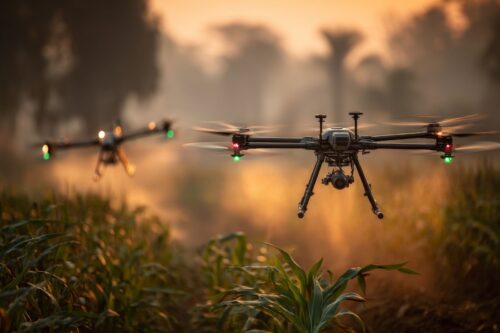
Camera-Led Drone Swarms Take Flight Without GPS or Communication
Researchers at the Indian Institute of Technology (IIT) Bombay have developed a breakthrough control system that allows drone swarms to fly in perfect formation — without GPS or inter-drone communication. The innovation could transform how UAVs are used in surveillance, rescue, and military missions.
A Smarter Way to Fly
Vertical Take-off and Landing (VTOL) drones can hover, rise, and move without needing runways. They’re ideal for confined spaces, but controlling multiple drones together is complex. Traditionally, they rely on GPS, a central computer, or human operators for coordination.
Now, IIT Bombay’s Prof. Dwaipayan Mukherjee and research scholar Chinmay Garanayak have proposed a new “bearing-only” control scheme. It lets drones make decisions by observing nearby UAVs using on-board cameras. No GPS or data exchange between drones is needed.
Vision-Led Navigation
In this approach, each drone “looks” at its neighbors through its camera to understand its relative position and orientation. This simple but effective method uses less power, reduces weight, and works even when communication networks fail.
Because the system depends only on camera data, it is less prone to noise and interference. This makes the swarm more stable, efficient, and reliable — especially useful for stealth operations in GPS-denied zones or during communication blackouts.
Tackling a Complex Flight Challenge
VTOL drones can move in six directions but can directly control only a few. This makes them “underactuated systems,” which are notoriously hard to manage. Most existing UAVs control models simplify these dynamics, leading to instability during real-world missions.
The IIT Bombay team developed a model that addresses this challenge by accounting for position, velocity, force, and torque. Their control scheme guarantees stability and ensures that drones reach and maintain formation even from imperfect starting points.
Reliable in Every Scenario
The research outlines two types of flight conditions — steady formation and time-varying movement. In steady scenarios, drones maintain formation using only bearing and bearing-rate data. For dynamic formations, where shapes or speeds change, the UAVs also use their own velocity readings.
This flexibility allows drones to adapt to changing environments — flying through tight spaces or switching formations mid-flight. The method can handle complex real-world missions where flexibility and precision are crucial.
Future of Autonomous Swarms
The team is preparing to test their control scheme on real drone swarms. Their next goal is to integrate collision avoidance while maintaining theoretical stability — something existing models lack.
As drones become vital tools in security, logistics, and disaster response, this innovation from IIT Bombay could set new benchmarks for autonomy and reliability in unmanned aerial systems.

FocusFlow: The Last Timer You'll Need
Master the art of deep work with our analog-inspired digital interface. Zero tracking, 100% focus.
Learn more
Exploring the intersection of human psychology and digital culture. Documenting the shift toward slow media and helping readers find balance in an attention-based economy.
View all articles